

Artificial Intelligence in the Classroom: Revolution or Threat?
A cheating scandal at Latin America's largest university, UNAM, throws a spotlight on AI's collision with education.

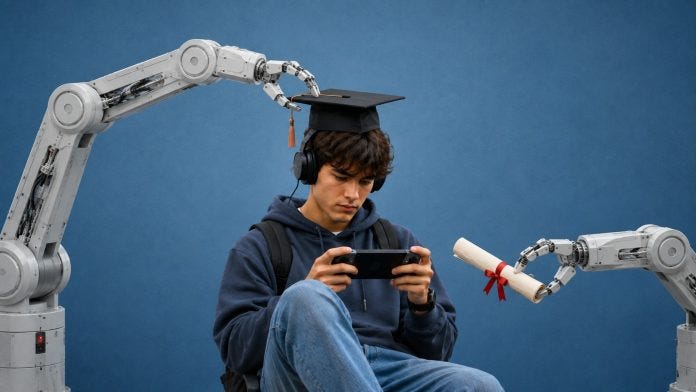
An online admissions exam has thrown Mexico’s top university, UNAM, into turmoil, plunging it into an ethics and prestige crisis. Suspicion arose that thousands of applicants had used artificial intelligence (AI) to cheat on the test. Doubts deepened after an unusual number of near-perfect scores appeared—the most in the university’s history.
A commission of education and AI experts ordered more than 50,000 students to retake the exam, this time in person. UNAM also removed its secretary-general and canceled its contract — worth more than USD 4 million — with Territorium Life, the education-technology company that had administered the online test.

President Claudia Sheinbaum said cases like this are pushing a return to “handwriting, to reading, to paper books, because there can be an abuse of artificial intelligence by students.” Mexican education authorities are now debating whether to ban children from using phones and tablets nationwide next school year, citing compulsive use. Half of the country’s states have already regulated it.
Our journalism is committed to protecting democratic values, reporting unbiased facts, verifying and contrasting, being independent.
In other words, #InvaluableJournalism
The case reopened debate in Mexico over the risks of AI and unchecked technology use in classrooms, but the problem isn’t new. Market research firm Ipsos surveyed more than 1,000 young people aged 18 to 25 in France and found that nearly 60% had used AI to cheat on exams.
The concern extends beyond AI use in academic work to the sheer omnipresence of devices. UNESCO says 58% of countries already ban mobile phones in schools, a policy it says “reflects growing concern over declining classroom attention, cyberbullying and the pervasive influence of digital environments on children.” Norway recently announced it will ban generative AI in classrooms next school year to prevent harm to the learning of students aged 6 to 13.
Ismael Martínez, a professor at UNAM’s Iztacala School of Higher Studies, says children spend too many hours glued to tablets and phones that spoon-feed them information. “They no longer have to imagine; they simply take in whatever the screen tells them,” he says. He believes it’s a serious issue if children no longer have room to think or be creative. “It isn’t about taking away the screen, but about thinking through what tools we can give them to develop those skills, and which ones are appropriate for their age.”
Bringing AI into classrooms also exposes students to algorithms built for profit. AI companies offering free services today have one goal: stratospheric earnings. Forbes counts more than 80 AI billionaires worldwide, with a combined fortune of USD 2.9 trillion. “And many more could follow,” the magazine warns.
UNESCO’s Assistant Director-General for Education, Stefania Giannini, writes in AI and the Future of Education that “education is increasingly a battleground for commercial AI models, which promise speed, efficiency and scalability, but threaten deep learning, reflection and human connection.” She notes that while these technologies open up learning possibilities, they can also inhibit critical thinking and widen gaps in access, gender, and language. “By generating data at an unprecedented scale, they also raise unanswered questions about privacy, ethics, sovereignty, and trust.” None of the companies involved seems eager to confront that problem.
AI also entrenches new forms of power while reproducing historic inequalities, leaving Latin America facing “a double vulnerability: digital dependency and institutional weakness.” Fabricio Cabrera Ortiz, a researcher at the Institute of Urban Studies of the National University of Colombia and author of the essay “Artificial Intelligence as a Weapon of Social Domination,” also points to a “techno-optimist narrative” that casts AI as a benevolent tool for social progress, a contested narrative that reaches students with no filter at all.
Microsoft, for instance, calls this a decisive year for AI, arguing it will “stop being just a tool and become an ally, transforming the way we work and create.” In its view, experts no longer talk about AI but about “AI agents,” since they are “establishing themselves as digital assistants capable of taking on specialized tasks, always under human supervision (…) At the same time, the technological infrastructure supporting this progress is also maturing, evolving toward smarter, more efficient systems,” the company’s global report states.
Still, Cabrera warns of a rapid expansion of algorithmic systems without democratic oversight, transparency or adequate ethical frameworks, a problem that is especially sensitive in education. Meta CEO Mark Zuckerberg recently released his “6,500-word manifesto,” proposing greater technological openness in AI even as the technology remains concentrated in a handful of hands.
Data centralization, opaque algorithms and the concentration of technological power in a few corporate hands have opened the door to what Cabrera calls an “algorithmic dystopia.” It amounts to “a non-deliberative model of governance in which decisions on security, mobility, health or citizenship are made not by people but by mathematical models carrying historic biases.” The trouble, he says, is that these systems follow an extractive logic aimed solely at amassing vast fortunes.
Your contribution makes a difference. Support CONNECTAS’s investigative journalism.
Latin American governments now face “an urgent need to establish robust, culturally sensitive regulations,” according to the first diagnostic report from the Latin American Council on Technology Ethics (CLET). In Mexico’s case, the trade agreement between Mexico, the United States and Canada requires non-discriminatory treatment for digital products, “which could limit the government’s ability to protect local AI systems from U.S. competition,” the report notes.
While several countries are trying to regulate AI, so far they have produced only “bills or policy strategies rather than fully enacted and detailed ‘AI laws,’” the CLET report states. Such regulation is critical: the report finds that 41% of young people aged 18 to 34 in the region “suffer disabling psychosocial distress, worsened by excessive screen use, cyberbullying and the fraying of community ties.”
For Cabrera, AI is therefore not neutral but a “political technology” on track to “consolidate a new, silent, technocratic and global regime of power, one that surpasses even the surveillance capacities of the 20th century’s authoritarian states.”
All of these points to major shifts in traditional teaching and learning. Machines “are rapidly becoming interactive actors and agents that respond, converse and engage with us as personalized tutors, companions and even teachers, redefining what it means to learn and to teach,” Cabrera says.
In this shift, teachers must find a new role in the classroom. As Martínez puts it, “some teachers still bring the same slides from 20 years ago, though the concepts today are completely different.” That doesn’t mean teachers are disappearing, he says; rather, their role is being redefined into that of a reviewer or content curator.
Martínez notes, though, that some universities have already replaced teachers with AI tools, and he experienced it firsthand. “I was fired from a university and replaced by a robot. Overnight, they told all of us: ‘there’s no more work, no more contract.’ And the robots began handling the lesson plans, instructional design, and platforms.” He believes some universities are doing this for financial reasons, “and it’s something we can’t avoid,” though he warns it comes at the cost of neglecting ethics and values training, for teachers and students alike, not just for responsible AI use but for life in general.
Still, nothing can change without the companies that control the data and algorithms, since they effectively set the limits of education. As Cabrera notes, these companies “oversee the ways we see, classify, predict and intervene in the world.” Latin America risks “being reduced to a region for data extraction, much as it once was for natural resources, and to a laboratory for algorithmic experimentation.” Without digital sovereignty or technological independence, these countries face “a silent colonization.”
This colonization unfolds amid what Susana Copertari, a researcher at the University of Rosario in Argentina and author of several books on AI and education, calls “the fourth narcissistic wound to human subjectivity.” The first came when Copernicus showed Earth isn’t the center of the universe. The second came when Darwin defined us as evolved animals. The third came when Freud warned that “we are not pure consciousness, that we have libido and desire.” The fourth arrived with AI, because “it hacked our most fundamental operating system, language. AI bots speak like us, in natural language. You don’t even notice. They imitate our voice.” A prospect that, applied to education, is unsettling.
Ultimately, education faces a complex dilemma: digital illiteracy on one side, and a virtualized education lacking the public policies to integrate it fairly and ethically on the other. Time is running out for teachers themselves, because, as Copertari puts it, while students already ride supersonic elevators, most of their teachers are still climbing the stairs.