

The Risks of Postdemocracy
Ortega scraps elections, Bukele seeks a presidency for life, and Trump and Petro both cry fraud. Why has democracy stopped being sacred?

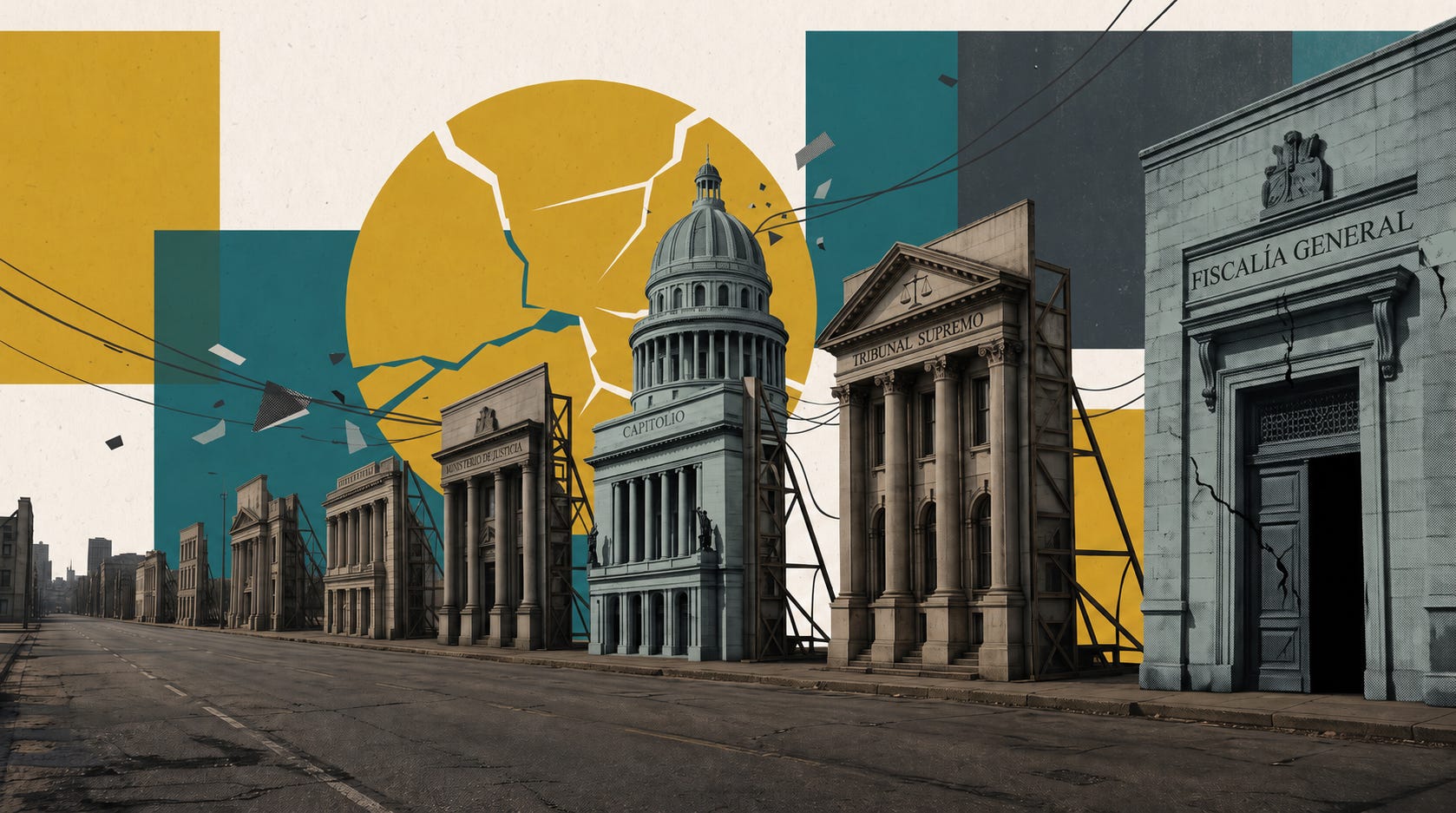
“Kim Jong Two.” The joke, which circulated widely online, compared Daniel Ortega to North Korea’s leader after the Sandinista strongman announced there would be no more elections in Nicaragua. Humor sometimes softens tragedy: in this case, the definitive burial of democracy through Ortega’s brutal honesty. It is a regime institutionalizing its dictatorship after years of staging elections amid an unprecedented authoritarian escalation.
Nicaragua has now officially joined the list of 92 autocracies worldwide, according to the V-Dem Institute’s 2026 Democracy Report. Meanwhile, only 87 democracies remain, which the weekly The Economist splits into 24 full democracies and 63 flawed ones. Democracy, in other words, remains rare: 74% of the world’s population, 6 billion people, now lives under authoritarian rule.
The V-Dem Institute, which tracks the state of democracy worldwide, warns of a broader backslide: global democracy levels have fallen back to those of 1978, all but erasing the gains of the so-called “third wave” that began in the 1970s.


Curiously, despite Nicaragua, Latin America and the Caribbean have improved their democratic standing more than any other region, according to The Economist’s index. “After nine years of decline, scores rose in more than half the region’s countries, driven by higher political participation,” the report says. The region also has the second-highest share of people living in democracies, at 71%.
Our journalism is committed to protecting democratic values, reporting unbiased facts, verifying and contrasting, being independent.
In other words, #InvaluableJournalism
Despite this relative optimism, there is a clear democratic disillusionment underway in the 21st century, a phenomenon Spanish political scientist Manuel Alcántara Sáez calls postdemocracy. In an article for El País, he splits it into three strands: the self-destruction of democratic regimes (Putin, Chavismo, Ortega, Bukele); the blocking of inclusion, diversity, and equality policies alongside the creation of scapegoats to absorb public anger (Trump, Milei, Noboa); and the success of Chinese authoritarianism. “Postdemocracy, in short, is an uncertain space that responds to the challenges of the digital society, while also being a consequence of the historical siege facing representative democracy and of its failures in confronting citizens’ problems and addressing their demands,” Alcántara concludes.
Nicaraguan sociologist Elvira Cuadra agrees the region is in a democratic crisis. But she does not single out her own country, arguing that “what’s happening with Ortega isn’t new. It’s one more step in the authoritarian radicalization of his family’s political project.” Instead, she points to the “authoritarian populisms” embodied by figures like Nayib Bukele.
“Democracy isn’t limited to political matters, and even less to formal ones, like actually being able to exercise your right to vote every so often,” Cuadra argues. “It also has to do with how people interpret whether that political environment actually improves their living conditions, their prospects, and those of their families. And on that front, democracy is being seriously questioned.” In Latin America, the system has failed to resolve critical, structural issues such as poverty, exclusion, inequality, and violence: “Insecurity and the fight against organized crime have become one of the justifications for significantly rolling back citizens’ rights in different countries.”
American political scientist Steven Levitsky, author of How Democracies Die, is also troubled by the Bukele model. He argues that in Latin America, “nobody wants to be Daniel Ortega, who’s a somewhat ridiculous old man; nobody wants to be Cuba either, or Venezuela. But Bukele, yes, he’s the only example in the world of a successful authoritarianism, and that’s what’s most contagious for the region.”
Bukele, the most popular head of state in Latin America with 67% approval according to CB Global Data’s monthly survey, has announced he will seek another term, brushing aside every constitutional limit to become a “president for life.” This tug-of-war with democracy has ugly precedents: Ortega himself, Chávez in Venezuela, and Evo Morales in Bolivia. Years earlier, Alberto Fujimori pioneered the same playbook in Peru, though he was later sentenced to 25 years in prison. His daughter Keiko has just taken office as president—a curious twist of fate for a country accustomed to unprecedented political swings.


Uruguayan analyst Adolfo Garcé argues that Latin America is less the continent of inequality than “the continent of dictatorships.” He points out that “the monarchical tradition inherited from colonial times” and the authoritarianism that also runs through Indigenous societies it’s a very powerful tradition, “and a hard one to bend.” In the absence of kings, the region grew dictators instead.
The Trump Factor
The V-Dem Institute’s 2026 report singles out the United States, the birthplace of the world’s largest democracy, which just turned 250, for particular alarm. For the first time in more than half a century, the country is losing its traditional status as a liberal democracy, driven by Donald Trump and his “ongoing autocratization.”
Levitsky agrees this should raise alarms. “The golden rule of democracy is that you accept election results, win or lose. And Trump has never accepted an election result; he’s one of the most anti-democratic figures in the country’s history.”
Garcé, for his part, is somewhat more optimistic about the fate of American democracy. However, he remains wary of Trump: “If any country prepared itself against tyranny, it was the United States. They built a strong Congress, a strong judiciary, and divided power territorially too, an aggressive decentralization with powerful local governments.” All of that was designed to prevent figures like Donald Trump from emerging. And even so, “with all that institutional architecture, one showed up anyway. A president who thinks he’s a king slipped through that carefully designed system.”
Your contribution makes a difference. Support CONNECTAS’s investigative journalism.
Bukele isn’t the only one following Trump’s lead; the pattern is spreading among Latin American politicians on both left and right. In Colombia, President Petro has likewise refused to accept his candidate’s defeat to Abelardo De la Espriella, who himself hasn’t shied away from antidemocratic gestures, including verbally attacking his opponents.
Such attitudes take hold easily among large segments of the public. In an era of hyperpolarization, elections are often decided by just a few hundred thousand votes and rather than granting legitimacy to the winners, this emboldens the losers to tear down their credibility. It’s the invisible thread linking Petro to Trump, and to Jair Bolsonaro.
So, is liberal democracy as we knew it coming to an end? There’s no consensus. Levitsky, despite his pessimism about Trump, believes “nobody is out in the streets demanding the Chinese model, or the one Ortega just invented. I don’t think there’s another country in Latin America ready to say ‘goodbye to elections.’ And I think that’s still very strong in the region’s political culture.”
Cuadra, for her part, foresees, particularly in Central America, “fairly limited democracies, because the underlying problems aren’t being addressed, and countries are trying to solve them by copying the Bukele model. The thing is, that model works in El Salvador—we’ll see for how long… but it’s very unlikely to work elsewhere.”
Garcé, finally, points to democracy’s cyclical nature: “We had a wave of democratic expansion in the seventies, and now we’re in a small counter-wave. Democracy expands, frustrates, breeds dissatisfaction, retreats… but fortunately, citizens eventually come to understand that authoritarianism is much worse than democracy with all its flaws.”