

The Southern Command: Washington’s New Frontier of Power in Latin America
Amid an unprecedented expansion of the American military presence in Latin America, how far will the region’s divide into Washington’s friends and foes go?

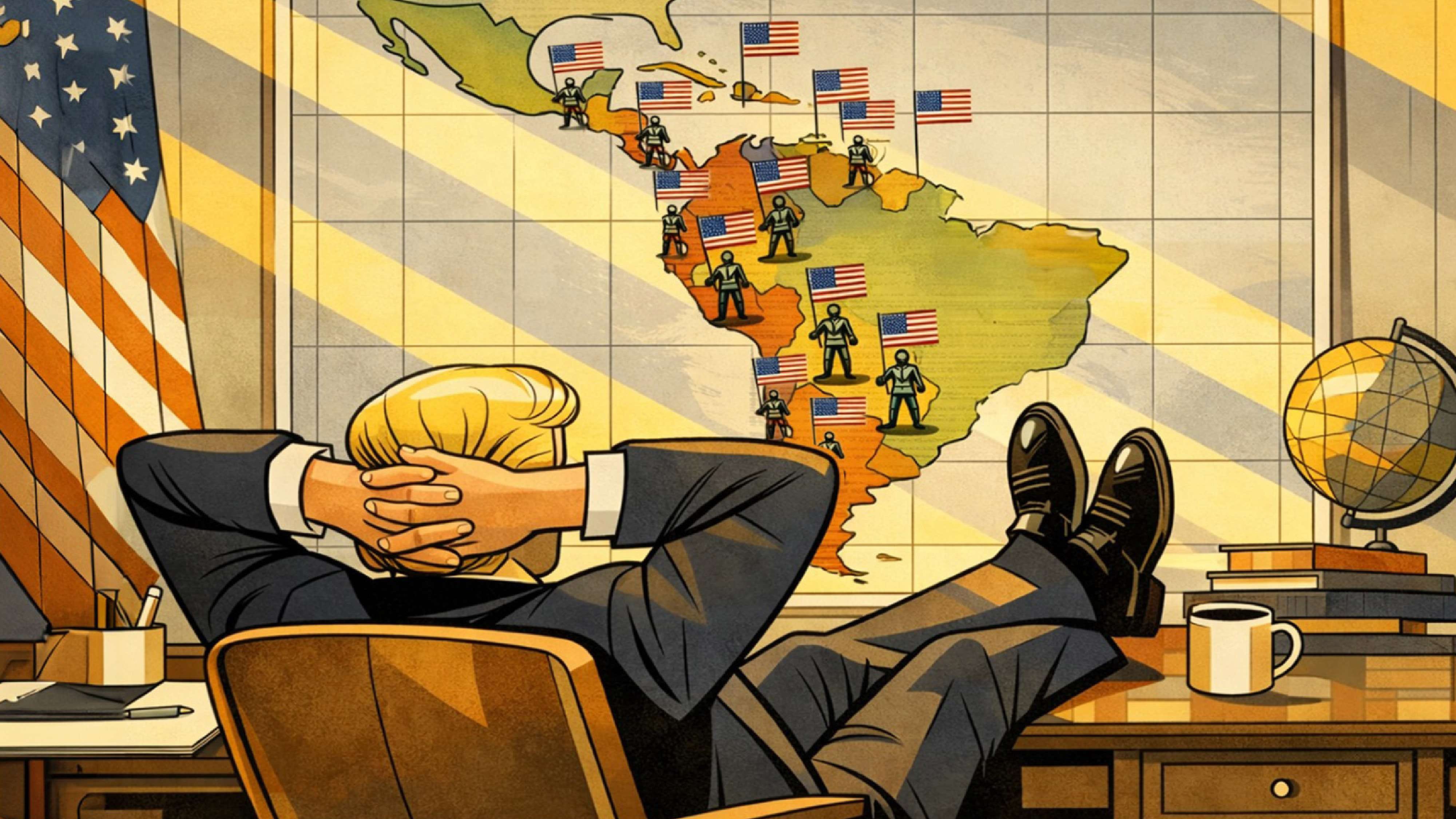
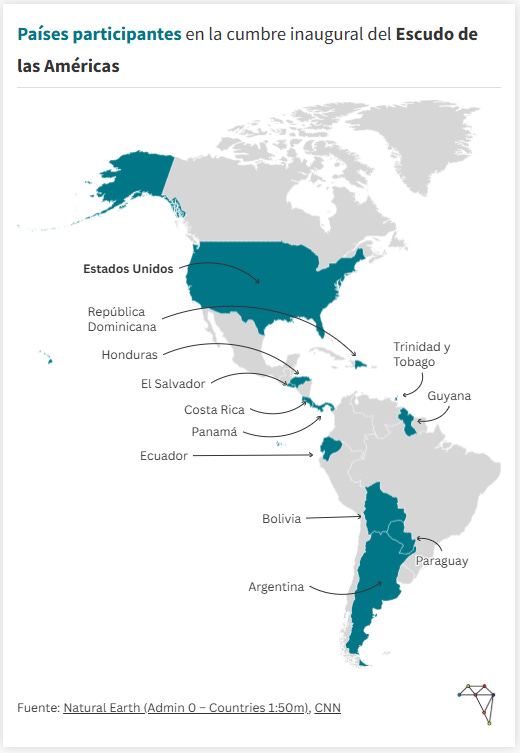
In recent months, the U.S. Southern Command has undergone a significant transformation. At first glance, this seemingly bureaucratic reorganization revealed a shift in Washington’s priorities in Latin America. These priorities were made evident in the so-called Shield of the Americas, an informal agreement between Donald Trump and 12 presidents of the region, and in the new motto of the so-called “War Department”: “Peace through Strength.”
In this new scenario, the White House has redesigned hemispheric geopolitics, and it drew a clear line: on one side, allied governments it considers trustworthy; on the other (outside that circle of trust) those he regards with suspicion. And in this change, military power is no longer a secondary actor.
In fact, a few months earlier, last December, the U.S. Army created the Western Hemisphere Command (West-Hemcom) to unify the decisions of the Northern and Southern Commands. Furthermore, it redefined the role of the Western Hemisphere Institute for Security Cooperation (WHINSEC), which replaced the School of the Americas two decades ago. From now on, that organization is no longer purely academic and is now aligned with the operations of the Army’s new unified command.
And, to conclude, just before the Shield of the Americas Summit in Doral, Florida, the defense ministers of 17 countries in the region signed a joint security declaration with Secretary of War Pete Hegseth, pledging to coordinate actions against drug cartels and criminal organizations operating in the hemisphere. The one-pager seeks to create a U.S.-backed coalition and underscores the importance of cooperation among governments “with mutual interests.”


For some analysts, such a brief declaration leaves ample room for interpretation. However, Adam Isacson of the Washington Office on Latin America (WOLA) explained that this series of defense changes, agreed upon behind the scenes, makes it clear that the United States will invest more federal funds in military aid programs in Latin America, including intelligence, training, and exchanges with Latin American military forces—something not seen in decades.
As Isacson told CONNECTAS, “they are trying to change the military culture. Hegseth, in his speech in Doral, said that Southern Command had been dominated for too long by lawyers, social workers, and NGO staff, and yes, they had a robust human rights initiative, but obviously for the United States, human rights are not such a priority nowadays. If they are seeking to impart or share those perspectives on military lethality at all costs regardless of human rights, those are quite toxic messages.”
This shift is consistent with Trump’s actions since he made his way back into the White House in January 2025. In one of his first moves—cutting cooperation funds, such as those from USAID—the president gave one of the first signals that the relationship with Latin America would be different in this second term. Trump doesn’t hide the fact that he wants a political coalition to extend the “homeland defense” doctrine with partners who will assist him on issues such as narco-terrorism and foreign threats.
“What stands out is a coalition of willing partners characterized by a pragmatism that does not focus so much on the quality of governance, corruption, or human rights records, but rather on who is willing to collaborate with the United States,” R. Evan Ellis, PhD, a professor of Latin American studies at the Institute for Strategic Studies at the U.S. Army War College, told CONNECTAS.
“Good” and “Bad”
But beyond the list of ideological allies—which includes the leaders of Argentina, Ecuador, Paraguay, El Salvador, or Chile, to name a few—what stands out is the list of those excluded: Brazil, Colombia, and Mexico, precisely the nations facing the greatest challenges regarding drug trafficking and organized crime groups. For Ellis, the failure to invite these three countries reveals that, with the Shield of the Americas, Trump aims above all to create a political bloc. The expert clarified that Colombia, Brazil, and Mexico do collaborate in the fight against drug trafficking and organized crime; however, he asserted that such support—at least in the case of Mexico and Brazil—is channeled primarily through diplomatic channels and is not as prominent as the approach Washington intends to take with its ideological allies.
This contrast between countries inside and outside the circle is also reflected in the tone the White House has adopted toward some of them. Following the capture of Nicolás Maduro in January, Trump hasn’t bothered to conceal the fact that his next target is in the Caribbean. This week he went so far as to state that it would be “a great honor” for him to “take Cuba,” amid tensions over the energy blockade against the island. “I think I can do whatever I want with it,” he said. “It’s a very weakened nation right now.” The words eloquently illustrate his vision of unilateral power.
For now, the Shield of the Americas is already showing its military face in the region. First, on March 6, Ecuadorian and American troops bombed drug trafficking bases in the province of Sucumbíos, on the border with Colombia. In a statement, U.S. Southern Command claimed that these operations “are a powerful example of the commitment of partners in Latin America and the Caribbean to combat the scourge of narco-terrorism.” And on the 16, President Gustavo Petro denounced a similar incident on the Colombian side. The president said they would investigate before making any decisions. “We do not want to go to war. I am proud to have removed Colombia from the danger of missiles. This is an era of missiles, of death to humanity, threat after threat. We have no reason to be bombed. National sovereignty must be respected,” Petro said.
His counterpart from Ecuador, Daniel Noboa, one of the signatories of the Doral Declaration, had already launched a tariff offensive against Colombia, interestingly shortly after meeting with Trump at the annual Davos meeting in Switzerland. And in an interview right after the presidential summit, Noboa avoided mentioning that Mexico, Colombia, and Brazil were not invited and, instead, noted that if they did not attend, it was “because they don’t want to solve the problem for some reason (...) I don’t see a real intention on their part to put an end to these narco-terrorist groups.”
Greater Presence
According to the WOLA expert, the United States seeks to conduct “many more joint operations, not just equipment and training programs. They want to be on the ground alongside the military, advising forces across the region as they combat these groups, and the model we’re seeing in Ecuador is what they want to replicate in any country where there is what they call narco-terrorism.”
These are not the only operations carried out by the Southern Command in the region. Since late last year, they have bombed suspected drug-smuggling boats in the Caribbean and the Eastern Pacific, in attacks that have killed more than 150 people. Also, since January 3, when Nicolás Maduro was captured in Venezuela, that command has posted on social media the military exercises it is conducting a few kilometers off the Venezuelan coast. And a few days ago it was reported that the U.S. would deploy its USS Nimitz aircraft carrier to the southern part of the continent and, while crossing through Argentine waters, will conduct exercises with that country’s navy.

As Ellis pointed out, the United States “is prepared to use military forces and deploy them more extensively in the region—no longer just the Coast Guard and the DEA, but also using lethal force primarily in the Caribbean, but also in the Pacific. And, in a way, I could interpret that the presidents who were present at the meeting (with Trump) share that disposition.”
This is an unprecedented scenario: security cooperation is no longer driven by diplomacy or multilateralism, but by coalitions operating under a shared ideology and with ambiguous criteria for action. As Isacson warned, within the Trump administration, a faction is pushing to create “a MAGA bloc in Latin America”—an alliance based on political affinity rather than on actual capabilities to confront threats.
In this new hemispheric landscape, security is no longer a shared project but an instrument of power that Washington intends to wield. As an example, Hegseth stated the following during the defense ministers’ summit: “The United States is prepared to confront these threats and go on the offensive alone, if necessary. However, we prefer that, for the benefit of this hemisphere, we do so together—with you, with our neighbors, and with our allies who are willing, eager, and capable of doing so.”
It remains to be seen whether this new defense architecture–one that is taking shape at breakneck speed and without checks and balances–will ultimately push the region into a cycle of tensions that are beginning to loom on the horizon.