

Visa Cancellations, Trump’s Weapon Against Dissent
In another attempt by the U.S. to control Latin America, board members of one of Costa Rica’s top newspapers were punished for their critical editorial line.

Before officially beginning her term, Costa Rica’s new president, Laura Fernández, thanked her predecessor Rodrigo Chaves, whom she described as “a man of principles and values, a caring leader, and a president who was always approachable.” The fact is that in this “new” phase of government, the popular politician is leaving office, but not power, as he will simultaneously assume the roles of Minister of the Presidency and Minister of Finance. In short, a “super-minister” with perks to maintain his immunity and even placate legal investigations against him.
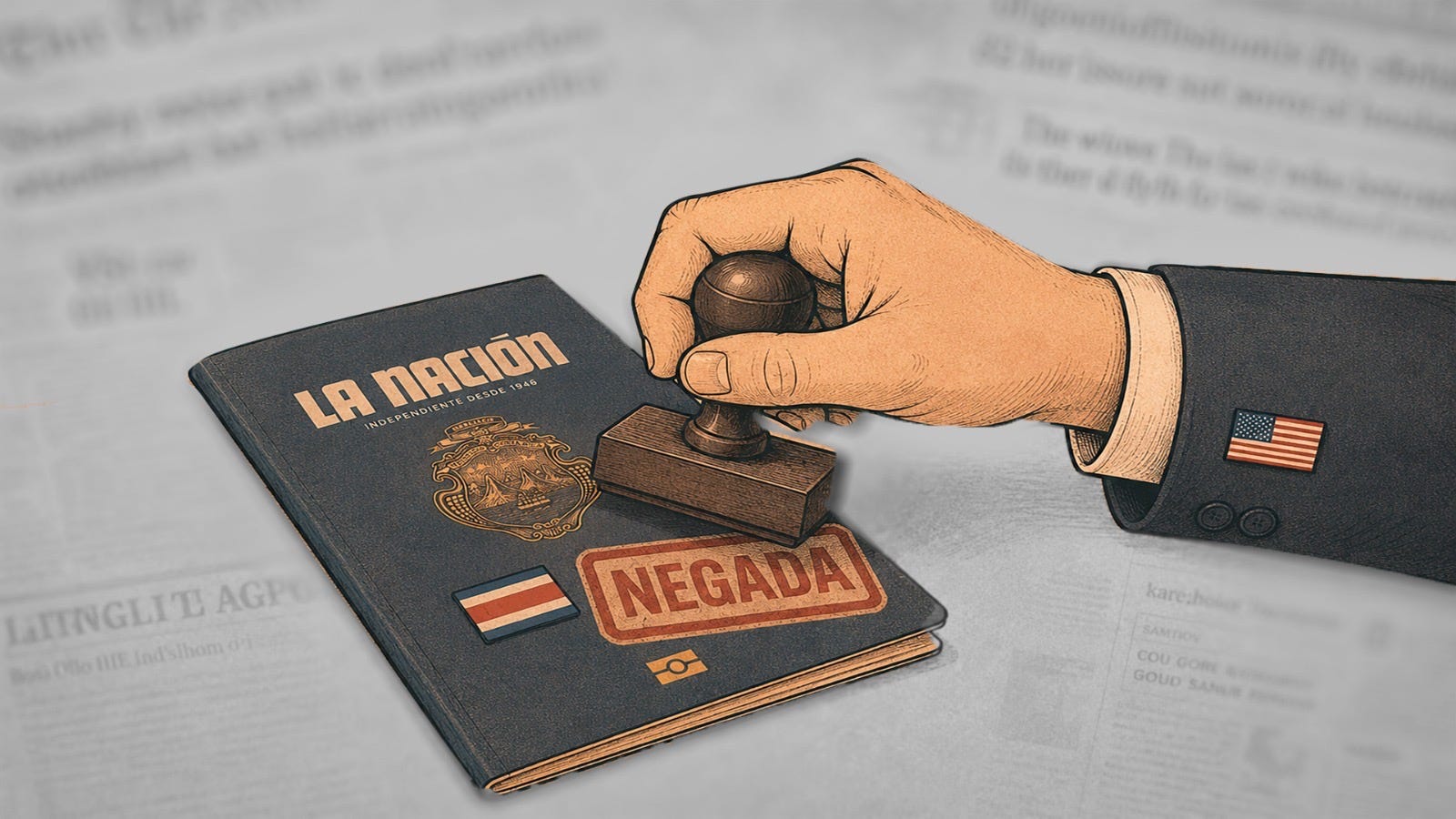
While this is happening in the circles of power, on the side of the Costa Rican press, alarms regarding censorship and intimidation are ringing loud and clear. On May 2, five of the seven members of the board of directors of the renowned newspaper La Nación were taken by surprise when the United States revoked their visas.
This measure is considered “unprecedented” in the industry, but there are other cases to consider. In February 2025, two congresswomen of the opposition lost their visas because they questioned the exclusion of Chinese companies from a multimillion-dollar public contract. Some critical lawmakers and officials suffered the same fate, as did respected former president and Nobel Peace Prize laureate, Óscar Arias, who has consistently criticized Donald Trump. “The United States is a model of democracy, or at least it used to be. Today it has elements of autocracy, unfortunately in my view. But who am I to tell him to mend his ways?” he told the media, though he ruled out that the Chaves government had anything to do with the decision.
But until now, this measure had never affected journalists. Since the Embassy has not explained the reasons, La Nación believes it could be a “punishment” for its journalistic independence, as stated in its May 4 editorial: “Today we have very solid reasons to assume that this is not just, nor so much, about what is being thought in Washington; many elements also point toward the Presidential House in Costa Rica. The convergence of the two makes both the method and the motives behind it alarming. They not only seriously undermine freedom of expression but also the integrity of our democracy.”
As Fabrice Le Lous, editorial director of La Nación, explains to CONNECTAS, this is part of a “polarizing populist political project that seeks to divide the country into good and bad.” That is why they need enemies—something akin to Steve Bannon’s strategy in the United States of throwing out highly scandalous issues to set the agenda (…) When we connect the dots, we see common denominators, such as the cancellation of visas for individuals, politicians, businesspeople, and judges whom the government, in one way or another, has labeled as enemies—but not for those linked to the government itself.”
The issue has a long history. For years, the newspaper has covered the World Bank’s internal investigation into Chaves for “sexual harassment” when the now-former president held a high-ranking position at that institution. It has also published several cases of alleged corruption, including irregular campaign funding, and has consistently challenged “authoritarian” stances as an affront to the democratic system. It is no exaggeration to say that La Nación became a thorn in the side of the conservative politician.
Characters such as Chaves have a textbook response in these contexts: “Vile press,” he says, openly expressing his intentions to destroy the newspaper and Canal 7, a major television network in the Central American country.
Our journalism is committed to protecting democratic values, reporting unbiased facts, verifying and contrasting, being independent.
In other words, #InvaluableJournalism
Politicized Visas
Chaves’s closeness to the current American administration is not a secret: he has openly cooperated to receive deportees from other countries and extradite alleged drug traffickers. Added to this is his participation, alongside his successor Laura Fernández, in the regional summit “Shield of the Americas,” President Trump’s initiative to align like-minded leaders on various issues of regional interest.
From what we have seen from the Trump administration in recent months, immigration restrictions appear to be the practical strategy to punish its political adversaries. That explains why former American Ambassador John Feeley does not hold back: “The message that President Trump’s administration is sending is that it is more than ready to politicize the visa process.”
For the seasoned diplomat, the consular function has been politicized, and the applicant’s beliefs and opinions now carry more weight than ever in visa decisions. “It is a shame and a betrayal of what has been a national security function. They have turned it into a weapon of revenge against those who think differently from the Trump administration,” Feeley explained to CONNECTAS.
And the action against the members of La Nación’s board of directors has given this policy a new dimension. The Democratic members of the House Foreign Affairs Committee rejected the measure: “This action against La Nación by (Marco) Rubio’s State Department is the latest example of how American foreign policy is being used to serve the political interests of Trump and his allies, not those of the American people,” they stated in response to a report by journalist Vera Bergengruen of The Wall Street Journal.
There are more examples along these lines. In October 2025, the State Department revoked the visa of Paraguayan journalist Enrique “Kike” Gamarra due to a comment he made about the murder of right-wing activist Charlie Kirk. The journalist called him “a son of a bitch” and added that “he got what he deserved.” He later offered a public apology to the family.
In fact, Paraguay’s president, Santiago Peña, is very close to Trump, and his country could be one of the new destinations for immigrants, since he signed an immigration agreement with the United States in August 2025.
Feeley, based in Panama, recalls the case of Martín Torrijos and Ricardo Lombana, former presidential candidates in 2024, who had their visas revoked after issuing a statement in defense of the sovereignty of the Panama Canal. “This represents a pattern of behavior. There must be a justification that goes beyond mere statements against a specific government policy. For me, having served as a representative of the world’s most powerful country militarily for over three decades, the clearest sign of weakness is revoking a visa because someone thinks differently from you. The sign of strength is when you can allow dissent. And damn it, this is a newspaper, not an army (…) Actually, they’re showing us that they’re afraid of freedom of expression.”
Your contribution makes a difference. Support CONNECTAS’s investigative journalism
The Crackdown on the Press
In the recent Press Freedom Index by Reporters Without Borders (RSF), Costa Rica fell from 8th to 36th place, a concerning development in a country such as Costa Rica. “Press freedom and freedom of expression are two highly respected principles in Costa Rica, making it an exception in Latin America. However, certain journalists and media outlets have faced verbal attacks over the past year, and the executive branch has restricted access to public information,” the RSF report states.
According to Yanancy Noguera, a Costa Rican journalist and press freedom activist, the outlook is alarming. She identifies three key issues: First, her country lacks robust legislation to defend press freedom, although some aspects have improved. A second point is how the natural antagonism between the press and those in power has changed. Previously, the courts resolved cases of disagreement without delay and almost always in a manner favorable to journalism. “We never imagined that an unscrupulous individual would reach the presidency and do everything in his power to intimidate the press,” Noguera asserts.
Finally, in third place, the activist points to the institutional weakening that began under the government’s systematic, premeditated, and organized actions. “Despite everything, I believe that on a personal level, there is an enormous sacrifice on the part of journalists who are trying to do their jobs,” she adds.
The outlook remains bleak due to the continuation of Laura Fernández’s administration. Although there are few expectations of a change in its relationship with the press, there is a strong commitment among journalists to defend their profession and continue holding those in power accountable.
This scenario, with some variations, is repeated in countries across the region where authoritarian governments relentlessly attack independent media outlets. This is the case in El Salvador, where President Nayib Bukele recently froze the accounts and assets of the partners of El Faro, in a move considered illegitimate and an act of revenge for the critical reporting of this digital outlet.
Alarms are also ringing in Argentina after President Javier Milei decided to block access for accredited journalists to the Casa Rosada and even suspended the digital entry system used by national and international reporters.
The list of similar cases goes on and on. But in the midst of it all, the independent press’s commitment remains almost intact, resilient to authoritarianism or bullets. “This is our DNA; we’re going to do journalism better than anyone else, and let’s hope the day never comes when we have to go into exile or when power is fully exploited to silence the press. Let’s hope Costa Rica doesn’t get to that point because it’s our turn to document the present,” says the editor-in-chief of La Nación.